• No products in the cart.

Molecular Docking Certificate Course

Learn the core principles, tools, and workflows of molecular docking — including AutoDock, ligand-receptor interactions, and protein preparation — all in one structured, beginner-friendly program.

Ratings:

Students Enrolled: 4721

Created By: Dr. Nikita Bora, Ph.D.
Price:

Original price was: ₹6,990.Current price is: ₹799.
Offer Expires In
Days
Hours
Minutes
Seconds
Just 3 Seats Remaining
17 out of 20 Enrolled Already

💡 Instant access | 🔒 Secure checkout.

This Online Course Includes

The course was very well designed and it helped me to understand different aspects of molecular docking and it’s applications.

Edwing Sedano

Why Learn Molecular Docking?

Molecular docking is one of the most essential skills in modern drug discovery and pharmacoinformatics. It allows you to simulate how drugs bind to biological targets — critical knowledge for anyone entering pharmaceutical R&D, academic research, or bioinformatics.

About The Course

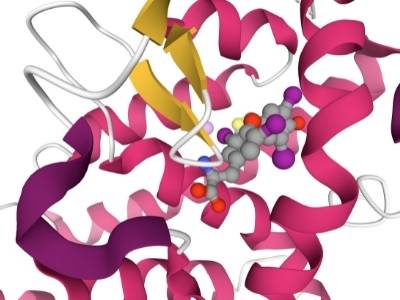
Molecular Docking Certificate Course is an in-depth, beginner-friendly program that teaches you the theory and practical steps behind molecular docking. You’ll gain real-world skills in docking software, ligand interaction, and protein-ligand complex preparation — without needing prior experience.

This is a 100% online, self-paced course created by experts in pharmacology and bioinformatics.

What You’ll Be Able To Do

By the end of this course, you’ll be able to:

Topics You’ll Cover

You’ll learn:

💡 All concepts taught with research examples — focused on practical understanding, not just theory.

Who This Course Is For

This course is ideal for:

✅ Whether you’re preparing for a thesis, pursuing advanced study, or simply adding new skills — this course gives you a practical foundation in molecular docking

Certification

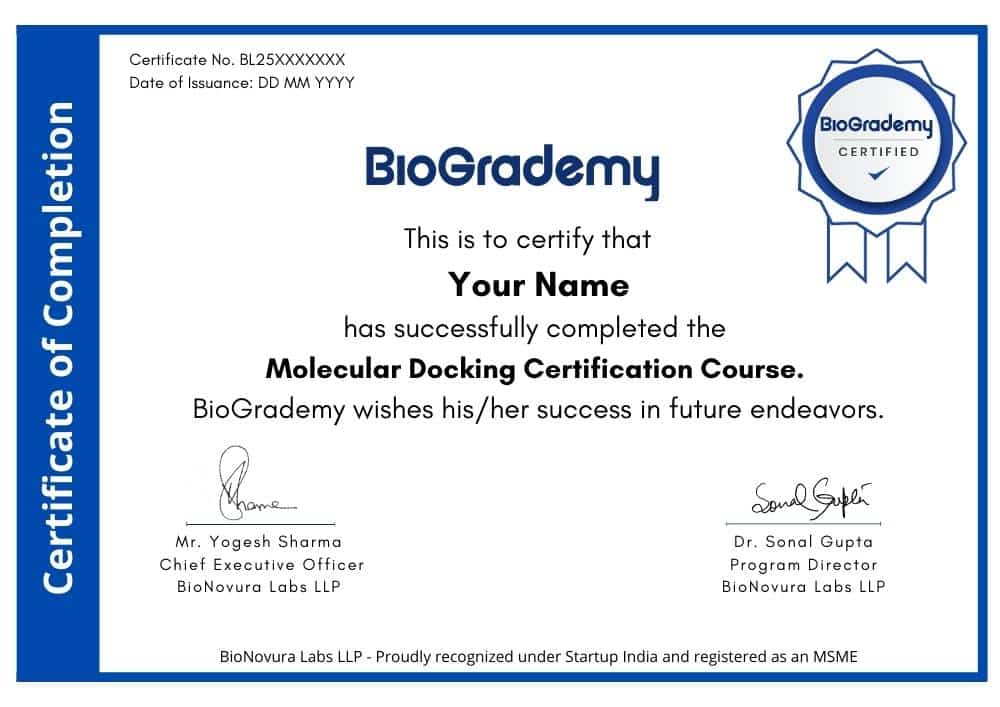
Upon completing the course, you’ll receive a Molecular Docking Certificate of Completion issued by BioGrademy.

Learn Molecular Docking Without Lab Access or Programming Skills
🧪 Master drug-target interactions, gain practical skills, and get certified today.

🕒 Limited Seats Left |💡 Instant access | 🔒 Secure checkout

Course Content

    • 1.1 Introduction to moleuclar docking 00:13:00
    • 1.2 Understanding the structure of protein 00:07:00
    • 1.3 Understanding the active site of a protein 00:08:00
    • 1.4 Understanding the ligand structure 00:06:00
    • 1.5 Protein ligand interactions 00:06:00
    • 2.1 Drug design 00:14:00
    • 2.2 Shift from traditional to computational biology 00:07:00
    • 2.3 Computer aided design and drafting 00:14:00
    • 2.4 Structure based drug design 00:15:00
    • 2.5 Virtual screening 00:17:00
    • 2.6 Structure based virtual screening 00:08:00
    • 2.7 Work-flow of multi-stage drug designing 00:16:00
    • 3.1 Workflow of molecular docking 00:14:00
    • 3.2 Molecular docking theory 00:21:00
    • 3.3 Ligand induced conformation 00:19:00
    • 3.4 Ligand poses 00:08:00
    • 3.5 Binding affinity 00:04:00
    • 3.6 Molecular docking task 00:06:00
    • 3.7 Molecular docking programs 00:07:00
    • 4.1 Types of biomolecular reactions 00:07:00
    • 4.2 Protein ligand docking 00:19:00
    • 4.3 Protein ligand docking example 00:05:00
    • 4.4 Protein-Protein docking 00:20:00
    • 4.5 Protein-Protein docking examples 00:26:00
    • 4.6 Protein-Peptide docking 00:15:00
    • 4.7 Protein-Peptide docking example 00:03:00
    • 4.8 Protein-DNA docking 00:24:00
    • 4.9 Protein-RNA docking 00:25:00
    • 4.10 Example 00:04:00
    • 4.11 HADDOCK 00:05:00
    • 5.1 Modes of molecular docking 00:05:00
    • 5.2 Rigid docking 00:16:00
    • 5.3 Illustration of rigid docking and its process 00:15:00
    • 5.4 Shifting towards flexible mode of docking 00:14:00
    • 5.5 Semi-Flexible docking 00:08:00
    • 5.6 Flexible Ligand, Rigid Protein 00:06:00
    • 5.7 Flexible docking – explanation 00:11:00
    • 5.8 Flexible docking-concept 00:14:00
    • 5.9 Flexibility of protein in drug discovery 00:08:00
    • 5.10 Example 1- CABS Dock 00:13:00
    • 5.11 Example 2 00:06:00
    • 5.12 Challenges of protein ligand docking 00:07:00
    • 5.13 Example 3 00:06:00
    • 6.1 Sampling algorithms – Introduction 00:03:00
    • 6.2 Semi-flexible docking- types 00:04:00
    • 6.3 Systematic search techniques 00:14:00
    • 6.4 Fragmentation search 00:14:00
    • 6.5 Conformational Ensemble 00:17:00
    • 6.6 Monte Carlo method 00:13:00
    • 6.7 Genetic algorithms 00:21:00
    • 6.8 Tabu search method 00:08:00
    • 6.9 Swarm optimization method 00:06:00
    • 6.10 Simulation method- molecular dynamics (example) 00:21:00
    • 6.11 Sampling Algorithms for flexible docking 00:10:00
    • 6.12 Soft Docking (examples) 00:15:00
    • 6.13 Side chain flexibility 00:17:00
    • 6.14 Multiple protein conformations 00:00:16
    • 6.15 Average grid method 00:05:00
    • 6.16 United description of the protein 00:13:00
    • 6.17 Individual conformations 00:15:00
    • 7.1 Pose selection (scoring functions) 00:13:00
    • 7.2 Scoring function components 00:09:00
    • 7.3 Classification of scoring function 00:21:00
    • 7.4 Empirical scoring fuctions 00:12:00
    • 7.5 Descriptors used in empirical scoring function 00:23:00
    • 7.6 Knowledge based scoring fuctions 00:17:00
    • 7.7 Evaluation scoring functions 00:12:00
    • 7.8 Databases for evaluating scoring functions 00:14:00
    • 7.19 Practical Session 1 01:00:00
    • 8.1 Understanding the structure file format- introduction 00:18:00
    • 8.2 Types of records in PDB 00:10:00
    • 8.3 Practical Session 2 01:00:00
    • 8.4 Docking target – handling the protein structure 00:28:00
    • 8.5 Prediction of active site & missing residues 00:15:00
    • 8.6 Practical Session 3- Prediction of active site & modeling missing residues 00:49:00
    • 8.7 Practical Session 4-Molecular Visualization Tool- Chimera 00:01:00
    • 9.1 Selecting the traget molecule 00:26:00
    • Practical Session – 5 00:15:00
    • 9.3 Practical session – 6 UniProtDB for receptor protein 00:28:00
    • 10.1 Practical Session 7 00:10:00
    • 10.2 Practical Session – 8 PubChem 01:00:00
    • AutoDoc Practical Session – 9 02:00:00
    • 12.1 Preparing the Protein – Practical Session 10 01:00:00
    • 12.2 Generating the grid parameter file – Practical Session 12 00:50:00
    • 12.3 Ligand molecule preparation – Practical Session 13 00:30:00
    • 12.4 Docking – Practical Session 14 00:51:00
    • 12.5 Analysis – Practical Session 15 00:53:00
    • 12.6 Analysis of the docked complex – Practical Session 16 00:55:00
    • 12.7 Molecular docking softwares 01:00:00
    • Applications of Molecular Docking 00:01:00

Learn Molecular Docking Without Lab Access or Programming Skills
🧪 Master drug-target interactions, gain practical skills, and get certified today.

🕒 Limited Seats Left |💡 Instant access | 🔒 Secure checkout

Reviews

  1. Amazing Course
    5

    The in-depth knowledge gained by completing this course is immense. I would suggest every individual to take this course. This will not just teach docking but all other aspects related to it.

  2. Best Molecular Docking Course
    5

    Best Course.

  3. BEST DOCKING SIMPLIFIED COURSE
    5

    best course

  4. useful
    5

    It was a very useful course. Practical sessions were more interesting.

  5. Jyoti VishwakarmaJuly 14, 2023 at 1:26 AM
    Molecular docking
    4

    Its really helpful

The course was very well designed and it helped me to understand different aspects of molecular docking and it’s applications.

Edwing Sedano

Welcome to BioGrademy

Take one step closer to your career goals with BioGrademy


We at BioGrademy thrive to evolve the way people learn and teach.

Reach Us

Reg. Office: BioNovura Labs LLP
(LLPIN: AAP-7184)
R Z – F – 33 – Kh No 594, Sadh Nagar,
South West Delhi, New Delhi, India,
Pin Code: 110045
Contact: +91-7696489079
Email: support@biogrademy.com

ISO Certified Organisation

LSSSDC Member

MSME Organisation


Warning: Array to string conversion in /home/shuclglv/public_html/wp-includes/formatting.php on line 1128

🚨 New: Data Science for Biologists Training

(Project + 2 Certificates)

X